
www.medical-devices.tech
23
'26
Written on Modified on
Robotic Arthroplasty Integration in Knee Replacement Systems
Smith+Nephew collaborated with orthopedic clinical centers to validate a robotic-assisted surgical knee implant following regulatory clearance.
www.smith-nephew.com
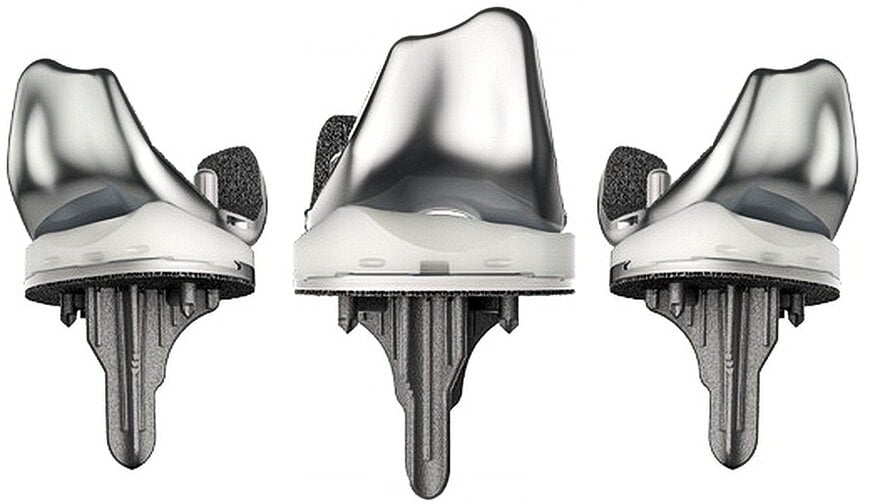
Smith+Nephew cooperated with orthopedic development partners, including the London Health Sciences Centre and the Hospital for Special Surgery, to introduce an anatomy-driven total knee arthroplasty platform. Medical device manufacturer Smith+Nephew engineered the implant architecture and instrumentation, while clinical partners provided surgical design input, procedural validation, and completed the initial surgical implementation.
The cooperation addressed biomechanical compromises common in conventional total knee arthroplasty, specifically unnatural patellar tracking and improper anterior-posterior positioning. Incorporating direct clinical feedback ensured the physical components interfaced with surgical robotics protocols in operating rooms.
Technical Parameters and System Architecture
The technical solution combines an anatomy-specific total knee replacement implant with handheld surgical robotics. At the hardware level, the system incorporates a fully 3D-printed femoral component produced with porous titanium CONCELOC technology to support bone ingrowth.
The articular architecture features a flattened trochlear groove entry geometry designed to guide patellar tracking along natural kinematics. The physical implant coordinates with the CORI KNEE handheld robotics platform, an intraoperative optical tracking and robotic milling system. Through digital resection planning and real-time ligament balancing interfaces, the handheld device guides bone preparation without requiring preoperative CT scans.
Clinical Deployment and Operative Workflow
The surgical system was deployed for its first clinical procedure at the London Health Sciences Centre in London, Ontario. The implant platform is engineered to function within hospital surgical suites as well as ambulatory surgery centers, accommodating decentralized healthcare infrastructure through the portable footprint of the handheld robotics platform.
Implementation was preceded by 510(k) clearance from the U.S. Food and Drug Administration, verifying safety and operational equivalence under medical device regulations. Orthopedic surgeons manage intraoperative resection alignment, while the digital tracking system dynamically controls the boundary limits of the cutting tool.
Applications and Mechanical Performance
Target applications cover total knee arthroplasty for patients requiring primary joint reconstruction due to degenerative joint disease. Operational advantages center on restoring native joint kinematics rather than forcing neutral mechanical alignment across diverse anatomical variations.
By stabilizing the anterior-posterior positioning of the joint axis and minimizing soft-tissue tension during flexion-extension cycles, the integrated platform aims to improve procedural repeatability, maintain component stability, and reduce manual surgical instrumentation footprint in sterile operating fields.
Edited by Evgeny Churilov, Induportals Media - Adapted by AI.
www.smith-nephew.com

