
www.medical-devices.tech
07
'26
Written on Modified on
Biphasic Aragonite Scaffold Enables Regenerative Cartilage & Subchondral Bone Repair
Smith+Nephew announced the commercial release of the CARTIHEAL AGILI-C Cartilage Repair Implant across European orthopedic surgical markets.
www.smith-nephew.com
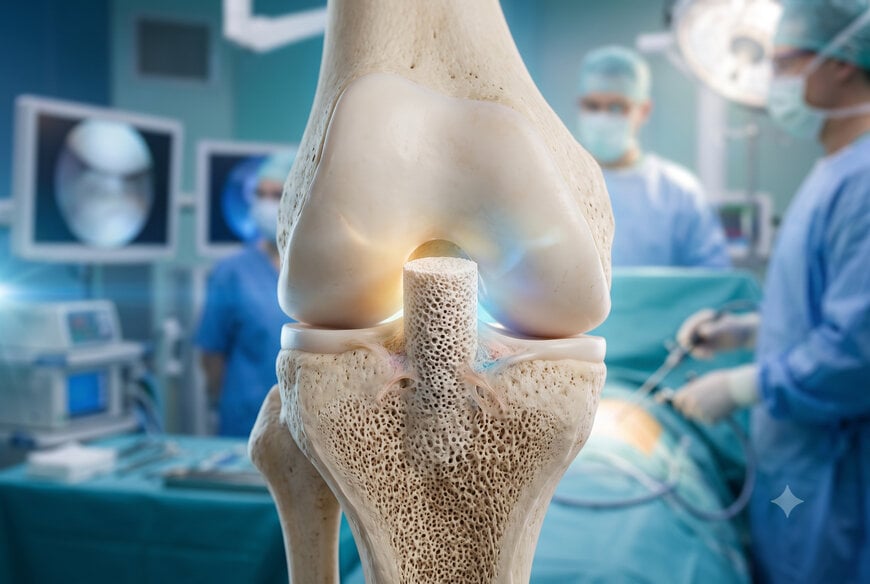
AI Generated Image
Articular cartilage lesions and underlying osteochondral defects present significant clinical challenges due to the avascular nature of hyaline cartilage and its poor inherent regenerative capacity. Addressing the need for viable single-stage joint preservation solutions, medical technology manufacturer Smith+Nephew has launched its CARTIHEAL AGILI-C Cartilage Repair Implant in key European healthcare systems, providing orthopedic surgeons with an acellular bioactive scaffold designed for joint surface restoration.
Biphasic Material Architecture and Regenerative Mechanism
The CARTIHEAL AGILI-C device operates as an off-the-shelf, biphasic osteochondral scaffold engineered to stimulate coordinated simultaneous repair of hyaline cartilage and underlying subchondral bone. The core engineering matrix consists of aragonite, a crystalline polymorph of calcium carbonate derived from natural marine coral structures, modified with hyaluronate.
The porous architecture mirrors the physiological pore diameter, geometry, and interconnectivity of natural trabecular bone and chondral tissue. When implanted into an addressable osteochondral defect, the material functions as a passive osteoconductive and chondroconductive template. Capillary action draws host blood, bone marrow, and autologous mesenchymal stem cells from the surrounding subchondral bed into the matrix. As cellular proliferation and vascular remodeling occur, the scaffold undergoes controlled degradation while host tissues gradually deposit native hyaline articular cartilage at the joint surface and calcified bone tissue throughout the deeper layer.
Long-Term Clinical Performance and Outcome Metrics
Clinical efficacy metrics supporting the European market expansion derive from a multicenter, randomized controlled trial published in the American Journal of Sports Medicine. Investigators tracked clinical endpoints out to 60 months against surgical standard of care, which typically encompasses microfracture or debridement procedures.
Patients treated with the AGILI-C scaffold demonstrated statistically superior scores on the Knee Injury and Osteoarthritis Outcome Score (KOOS) instrument through the five-year evaluation window. Statistically significant gains were recorded across pain reduction, functional mobility, and activities of daily living at 24, 48, and 60 months. Comparative data indicated no statistical difference in clinical success rates between patients presenting with isolated chondral defects and those with mild to moderate baseline osteoarthritis, expanding the eligible patient demographic beyond conventional microfracture indications.
Surgical Workflow and International Clinical Dissemination
The off-the-shelf structural design bypasses the multi-stage operational overhead associated with cell-seeded therapies, eliminating the requirement for primary cell harvest, external ex vivo cell culturing, and secondary surgical implantation. Surgeons insert the cylindrical scaffold using standardized coring and press-fit insertion instruments directly into the prepared defect site during a single-stage arthroscopic or mini-open procedure.
Smith+Nephew scheduled the presentation of the clinical data at the International Cartilage Regeneration and Joint Preservation Society (ICRS) Summit in Porto, Portugal, running from October 8 to 10. Initial commercial availability covers healthcare institutions in Austria, Belgium, France, Germany, Ireland, Italy, Luxembourg, Netherlands, Portugal, Spain, Switzerland, and the United Kingdom. Dr. Francesca de Caro, orthopedic specialist at Pavia Hospital in Italy, noted that the treatment of complex osteochondral defects remains technically demanding and that expanding access to regenerative scaffolds improves surgical intervention options for challenging joint preservation cases.
Additional Context:
This section details technical specifications and competitive benchmarking not included in the original product announcement.
Conventional intervention techniques for full-thickness cartilage defects generally divide into marrow stimulation and cell-based grafting. Marrow stimulation, primarily microfracture, remains the traditional surgical baseline; however, microfracture frequently produces mechanically inferior fibrocartilage composed of Type I collagen rather than resilient Type II hyaline cartilage, often leading to structural deterioration within 24 to 36 months under high mechanical loads.
Autologous Chondrocyte Implantation (ACI) and Matrix-Induced Autologous Chondrocyte Implantation (MACI) provide regenerative repair with true hyaline tissue, but require a complex two-stage surgical process involving cartilage biopsy, off-site cellular expansion spanning multiple weeks, and specialized laboratory infrastructure, resulting in high total procedural costs. Synthetic polymer plugs, such as poly(lactic-co-glycolic acid) scaffolds, offer off-the-shelf single-stage alternatives, yet they can be susceptible to localized foreign-body inflammatory responses caused by acidic degradation byproducts.
The aragonite matrix utilized in AGILI-C provides compressive strength comparable to native human cancellous bone (10 to 30 MPa) to support physiological joint loading during remodeling. Degradation occurs primarily via osteoclastic resorption rather than hydrolytic acidification, buffering local tissue pH and supporting direct integration. Regulated as an implantable medical device, the platform was cleared in the United States by the Food and Drug Administration under Premarket Approval (PMA) following clinical trials assessing knee joint defects with an indicated defect size surface area of up to 7 square centimeters, filling a therapeutic performance gap between marrow stimulation and multi-stage autologous cell procedures.
Edited by Natania Lyngdoh, Induportals editor, with AI assistance.
www.smith-nephew.com
Articular cartilage lesions and underlying osteochondral defects present significant clinical challenges due to the avascular nature of hyaline cartilage and its poor inherent regenerative capacity. Addressing the need for viable single-stage joint preservation solutions, medical technology manufacturer Smith+Nephew has launched its CARTIHEAL AGILI-C Cartilage Repair Implant in key European healthcare systems, providing orthopedic surgeons with an acellular bioactive scaffold designed for joint surface restoration.
Biphasic Material Architecture and Regenerative Mechanism
The CARTIHEAL AGILI-C device operates as an off-the-shelf, biphasic osteochondral scaffold engineered to stimulate coordinated simultaneous repair of hyaline cartilage and underlying subchondral bone. The core engineering matrix consists of aragonite, a crystalline polymorph of calcium carbonate derived from natural marine coral structures, modified with hyaluronate.
The porous architecture mirrors the physiological pore diameter, geometry, and interconnectivity of natural trabecular bone and chondral tissue. When implanted into an addressable osteochondral defect, the material functions as a passive osteoconductive and chondroconductive template. Capillary action draws host blood, bone marrow, and autologous mesenchymal stem cells from the surrounding subchondral bed into the matrix. As cellular proliferation and vascular remodeling occur, the scaffold undergoes controlled degradation while host tissues gradually deposit native hyaline articular cartilage at the joint surface and calcified bone tissue throughout the deeper layer.
Long-Term Clinical Performance and Outcome Metrics
Clinical efficacy metrics supporting the European market expansion derive from a multicenter, randomized controlled trial published in the American Journal of Sports Medicine. Investigators tracked clinical endpoints out to 60 months against surgical standard of care, which typically encompasses microfracture or debridement procedures.
Patients treated with the AGILI-C scaffold demonstrated statistically superior scores on the Knee Injury and Osteoarthritis Outcome Score (KOOS) instrument through the five-year evaluation window. Statistically significant gains were recorded across pain reduction, functional mobility, and activities of daily living at 24, 48, and 60 months. Comparative data indicated no statistical difference in clinical success rates between patients presenting with isolated chondral defects and those with mild to moderate baseline osteoarthritis, expanding the eligible patient demographic beyond conventional microfracture indications.
Surgical Workflow and International Clinical Dissemination
The off-the-shelf structural design bypasses the multi-stage operational overhead associated with cell-seeded therapies, eliminating the requirement for primary cell harvest, external ex vivo cell culturing, and secondary surgical implantation. Surgeons insert the cylindrical scaffold using standardized coring and press-fit insertion instruments directly into the prepared defect site during a single-stage arthroscopic or mini-open procedure.
Smith+Nephew scheduled the presentation of the clinical data at the International Cartilage Regeneration and Joint Preservation Society (ICRS) Summit in Porto, Portugal, running from October 8 to 10. Initial commercial availability covers healthcare institutions in Austria, Belgium, France, Germany, Ireland, Italy, Luxembourg, Netherlands, Portugal, Spain, Switzerland, and the United Kingdom. Dr. Francesca de Caro, orthopedic specialist at Pavia Hospital in Italy, noted that the treatment of complex osteochondral defects remains technically demanding and that expanding access to regenerative scaffolds improves surgical intervention options for challenging joint preservation cases.
Additional Context:
This section details technical specifications and competitive benchmarking not included in the original product announcement.
Conventional intervention techniques for full-thickness cartilage defects generally divide into marrow stimulation and cell-based grafting. Marrow stimulation, primarily microfracture, remains the traditional surgical baseline; however, microfracture frequently produces mechanically inferior fibrocartilage composed of Type I collagen rather than resilient Type II hyaline cartilage, often leading to structural deterioration within 24 to 36 months under high mechanical loads.
Autologous Chondrocyte Implantation (ACI) and Matrix-Induced Autologous Chondrocyte Implantation (MACI) provide regenerative repair with true hyaline tissue, but require a complex two-stage surgical process involving cartilage biopsy, off-site cellular expansion spanning multiple weeks, and specialized laboratory infrastructure, resulting in high total procedural costs. Synthetic polymer plugs, such as poly(lactic-co-glycolic acid) scaffolds, offer off-the-shelf single-stage alternatives, yet they can be susceptible to localized foreign-body inflammatory responses caused by acidic degradation byproducts.
The aragonite matrix utilized in AGILI-C provides compressive strength comparable to native human cancellous bone (10 to 30 MPa) to support physiological joint loading during remodeling. Degradation occurs primarily via osteoclastic resorption rather than hydrolytic acidification, buffering local tissue pH and supporting direct integration. Regulated as an implantable medical device, the platform was cleared in the United States by the Food and Drug Administration under Premarket Approval (PMA) following clinical trials assessing knee joint defects with an indicated defect size surface area of up to 7 square centimeters, filling a therapeutic performance gap between marrow stimulation and multi-stage autologous cell procedures.
Edited by Natania Lyngdoh, Induportals editor, with AI assistance.
www.smith-nephew.com

