
www.medical-devices.tech
22
'26
Written on Modified on
Advancements in Biomechanical Implants and Robotic Shoulder Arthroplasty
Smith+Nephew demonstrates integrated robotic surgical platforms and high-porosity biological implants designed to improve biomechanical load distribution in joint repair procedures.
www.smith-nephew.com
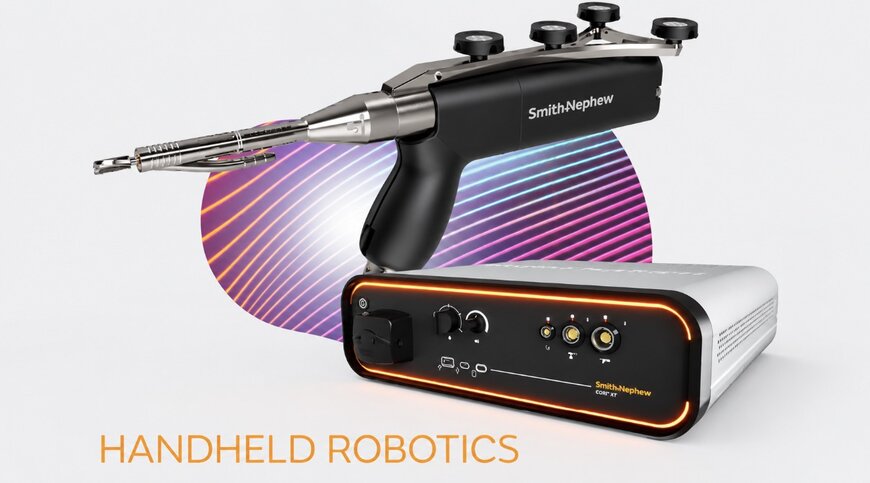
Smith+Nephew showcased a portfolio of advanced shoulder repair technologies, including bioinductive implants and handheld robotic arthroplasty systems, for orthopedic surgical applications. These systems integrate biomechanical fixation techniques and automated pre-operative modeling to improve soft tissue tensioning and anatomical accuracy during joint reconstruction and rotator cuff repair.
Optimizing Biomechanical Load Distribution
The hardware and biological solutions were presented at the International Congress for Shoulder and Elbow Surgery (ICSES) in Vancouver, held from September 22 to 25, 2026. A primary technical focus of the exhibition is the TENDON SEAM Rotator Cuff Repair System, which alters how mechanical forces are distributed across a repaired tendon. The construct utilizes multiple tightly spaced 2x10mm anchors connected by a continuous stitch, creating a fixation seam perpendicular to the direction of the load. This load-sharing architecture maximizes repair strength during the critical healing period. Biomechanical testing indicates a twofold increase in initial repair strength and a tenfold decrease in gap formation when compared to traditional surgical suturing techniques.
Bioinductive Tissue Regeneration
Addressing soft tissue healing, the REGENETEN Bioinductive Implant employs highly purified, highly porous, and oriented collagen fibers to stimulate the body’s natural physiological healing response and generate new tissue. For isolated partial-thickness rotator cuff tears, clinical studies show that this implant halves early recovery times relative to standard suture anchor repairs, while decreasing the overall risk of retearing. The system has recorded over 250,000 global procedures since its introduction in 2014 and aligns with the American Academy of Orthopaedic Surgeons (AAOS) 4-star recommendation for bioinductive implants.
Knotless Suture Fixation
To accommodate varying tissue and bone qualities, the newly launched Q-FIX KNOTLESS 2.8 All-Suture Anchor provides fine-tuned soft tissue tensioning within a knotless construct. By eliminating manual knot tying, the system offers structural reliability while allowing surgeons to adapt tension dynamically based on the specific anatomical requirements of the repair procedure.
Handheld Robotics and Pre-Operative Planning
Transitioning from soft tissue repair to total joint replacement, the company has integrated the AETOS Shoulder System into a comprehensive surgical technology ecosystem. The CORIOGRAPH pre-operative planning and modeling service works in tandem with the CORI SHOULDER Handheld Robotics platform to execute precision bone preparation on both the humerus and glenoid. The software supports both anatomic and reverse arthroplasty procedures. Utilizing the CORI XT hardware configuration, the platform relies on a minimized physical footprint, enabling seamless mobility between hospital operating rooms and ambulatory surgical centers without disrupting established clinical workflows.
Additional Context
This section details technical specifications and competitive benchmarking not included in the original news release.
In the orthopedic technology sector, handheld robotic arthroplasty systems like the CORI platform are benchmarked against robotic-arm assisted platforms, such as Stryker’s Mako and Zimmer Biomet’s ROSA systems. While robotic-arm systems utilize rigid physical constraints and haptic boundaries to guide a surgical saw or burr, the CORI system employs a handheld burring tool governed by a high-speed optical tracking system that automatically halts the burr if the surgeon moves outside the pre-planned 3D resection zone. This architecture eliminates the need for large robotic arm consoles, heavily reducing the hardware footprint in the operating room.
Additionally, the REGENETEN bioinductive implant competes in the biological augmentation market against structural dermal allografts, such as the Arthrex ArthroFLEX. The technical differentiation lies in the mechanism of action: whereas dermal allografts provide immediate mechanical and structural reinforcement to the tendon using decellularized human dermis, the highly porous bovine-derived collagen of the REGENETEN implant is engineered primarily to induce host cell proliferation and gradual tissue remodeling over the defect without adding significant mechanical bulk to the subacromial space.
Edited by Aishwarya Mambet, Induportals Editor, with AI assistance.
www.smith-nephew.com

