
www.medical-devices.tech
18
'26
Written on Modified on
Compact Centrifugal Separators for Low-Volume Biopharmaceutical Production
GEA introduced two pilot-scale disc stack separators designed to standardize process transfer, scale-up, and product recovery across pharmaceutical manufacturing lines.
www.gea.com
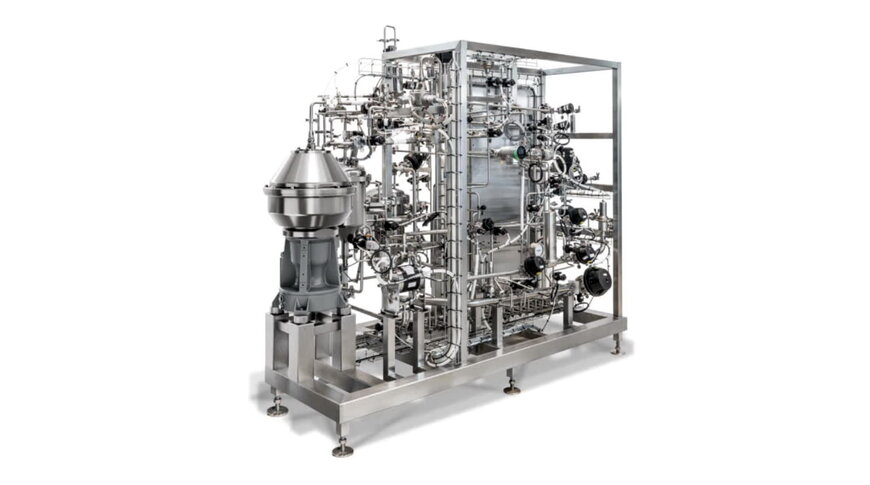
GEA expanded its disc stack centrifuge platform to address small-batch, clinical, and pilot-scale processing across the pharmaceutical and biopharmaceutical industries. The engineering framework integrates modular bowl geometry, integrated drive mechanics, and sanitary design to support process development and low-volume commercial production.
Bridging Pilot and Commercial Clarification Capacities
Downstream biopharmaceutical processing often faces operational discrepancies when transitioning cellular broths and fermentation streams from laboratory bench centrifuges to commercial manufacturing skids. The new models provide targeted throughput capacities between 250 and 500 liters per hour in clarifier configurations, and 350 to 600 liters per hour in nozzle bowl configurations. Operating within these ranges enables the platform to serve as an exact intermediate scale between laboratory systems and commercial units handling up to 20,000 liters per hour, ensuring continuous validation and predictable hydrodynamics during scale-up.
Interchangeable Bowl Geometries for Variable Solids Content
Process flexibility is governed by an interchangeable rotor arrangement termed the flexChange concept, which permits four distinct bowl configurations on an identical skid frame. Operators adapt the machine base to shifting feed characteristics by mounting specific geometries:
- The HighSigma clarifying drum handles low-solids separation for feed streams containing up to 5 percent solids by volume.
- The HighVol clarifying drum processes intermediate biomass densities up to 10 percent solids by volume.
- The flexiCon nozzle drum manages dense concentrates containing up to 30 percent solids by volume.
- The visCon nozzle drum processes viscous fluids that demand elevated throughput without clogging.
This multi-geometry capability eliminates the requirement for distinct separator skids across alternating cell culture harvest or extraction campaigns, raising plant capacity utilization and reducing capital expense.
Hygienic Execution and Direct-Drive Architecture
Mechanical and hygienic executions bifurcate across two operational standards. The pure version is configured for standard sanitary pharmaceutical standards, whereas the aseptic version provides full cleanroom compatibility, complete clean-in-place capabilities, and sterilization-in-place compliance using pressurized steam.
Both versions integrate an axial direct drive designated as the XDD concept. By eliminating mechanical gearboxes, drive belts, and external couplings in favor of a swappable drive cartridge, the mechanical design minimizes wear particles, dampens acoustic emissions, lowers electrical power consumption, and reduces physical equipment footprints within classified cleanroom spaces.
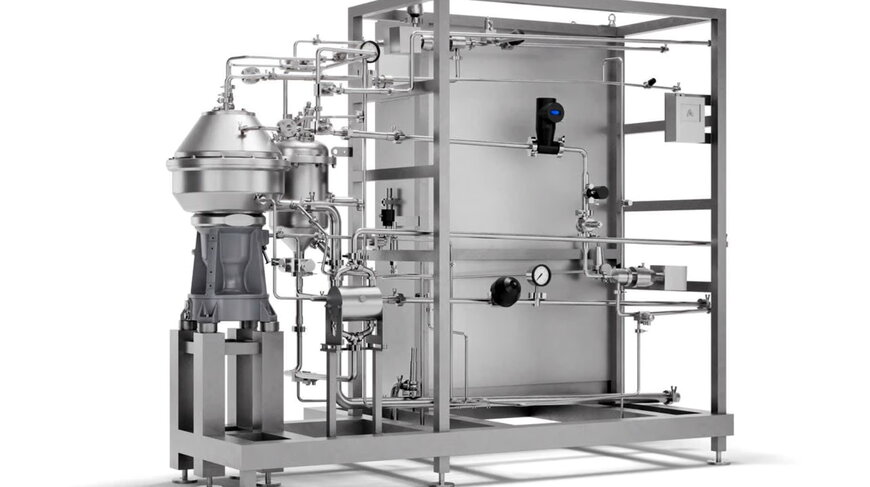
GEA presents the pure 15 model. (Photo: GEA)
Additional Context
This section details technical specifications and competitive benchmarking not included in the original product announcement.
In bioprocess fluid clarification, low-volume disc stack separators compete directly with pilot-scale offerings such as the Alfa Laval Culturefuge 100 and standard single-use depth filtration skids.
Compared to multi-stage depth filtration trains, disc stack separators eliminate recurring single-use filter consumable costs and scale linearly to multi-thousand-liter industrial capacities, though they require qualified clean-in-place utilities. Against comparable stainless steel systems like the Culturefuge series — which relies on hermetic hollow-spindle feed designs to minimize shear on shear-sensitive mammalian cells — the GEA platform differentiates primarily through mechanical versatility: the ability to switch between clarifying disc bowls and continuous nozzle discharge bowls on a single skid footprint enables operations covering bacterial, fungal, and mammalian expressions on the same pilot line.
Edited by Evgeny Churilov, Induportals Media - Adapted by AI.
www.gea.com
Hygienic Execution and Direct-Drive Architecture
Mechanical and hygienic executions bifurcate across two operational standards. The pure version is configured for standard sanitary pharmaceutical standards, whereas the aseptic version provides full cleanroom compatibility, complete clean-in-place capabilities, and sterilization-in-place compliance using pressurized steam.
Both versions integrate an axial direct drive designated as the XDD concept. By eliminating mechanical gearboxes, drive belts, and external couplings in favor of a swappable drive cartridge, the mechanical design minimizes wear particles, dampens acoustic emissions, lowers electrical power consumption, and reduces physical equipment footprints within classified cleanroom spaces.
GEA presents the pure 15 model. (Photo: GEA)
Additional Context
This section details technical specifications and competitive benchmarking not included in the original product announcement.
In bioprocess fluid clarification, low-volume disc stack separators compete directly with pilot-scale offerings such as the Alfa Laval Culturefuge 100 and standard single-use depth filtration skids.
Compared to multi-stage depth filtration trains, disc stack separators eliminate recurring single-use filter consumable costs and scale linearly to multi-thousand-liter industrial capacities, though they require qualified clean-in-place utilities. Against comparable stainless steel systems like the Culturefuge series — which relies on hermetic hollow-spindle feed designs to minimize shear on shear-sensitive mammalian cells — the GEA platform differentiates primarily through mechanical versatility: the ability to switch between clarifying disc bowls and continuous nozzle discharge bowls on a single skid footprint enables operations covering bacterial, fungal, and mammalian expressions on the same pilot line.
Edited by Evgeny Churilov, Induportals Media - Adapted by AI.
www.gea.com

