
www.medical-devices.tech
25
'26
Written on Modified on
Embedded Vision System for Laboratory Automation
Basler AG launches a configurable GMSL vision system for laboratory automation platforms and AI-based medical applications.
www.baslerweb.com
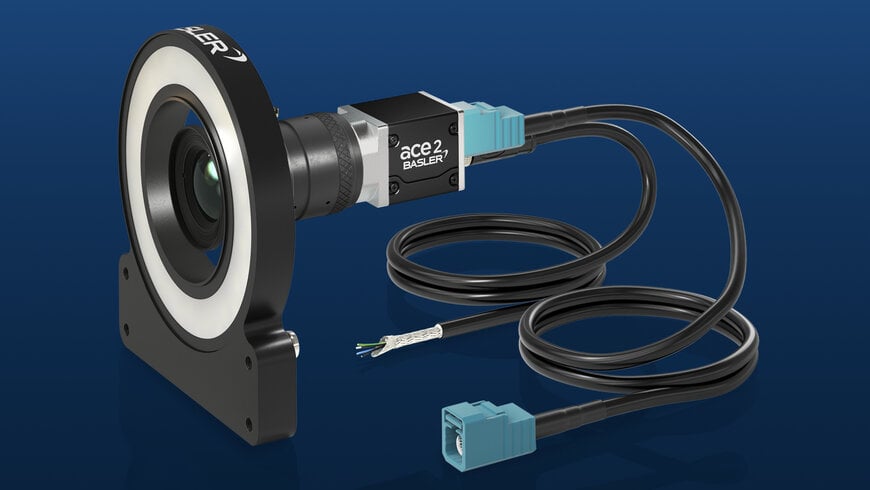
Basler AG has announced a complete vision system using the Gigabit Multimedia Serial Link (GMSL) embedded interface for high-throughput laboratory automation applications in the life sciences and medical diagnostics sectors. The solution combines industrial cameras, coaxial cabling, optics, lighting, and integration software to simplify real-time image processing on GPU-based platforms.
The system targets environments requiring low-latency, high-bandwidth image acquisition, including high-throughput screening platforms, cell analysis, digital pathology, and automated clinical result validation lines. The architecture is based on NVIDIA Jetson Orin processors to accelerate parallel processing workloads associated with machine vision and artificial intelligence models.
GMSL Architecture for Low-Latency Image Processing
The system uses the GMSL interface, an embedded video transmission technology designed to transport uncompressed image streams with low latency. This architecture addresses the requirements of laboratory automation applications involving synchronized multi-camera setups and real-time AI processing.
Basler states that machine vision workloads in automated laboratories increasingly rely on GPUs rather than traditional CPUs because graphics processors are better suited for parallel computations associated with image analysis and machine learning algorithms.
The ace 2 GMSL camera supports sensors with resolutions up to 24.4 megapixels and frame rates up to 170 frames per second. Onboard processing ensures GenICam compatibility, a widely used machine vision standard that enables software interoperability between imaging devices and processing platforms.
The system enables direct image data transfer to GPU-accelerated platforms, reducing intermediate conversion layers and simplifying the integration of automated laboratory architectures.
Coaxial Transmission and Multi-Camera Synchronization
The embedded vision system uses coaxial cables equipped with FAKRA connectors to simultaneously handle image data transmission and camera power delivery through a single cable connection. This approach reduces cabling complexity in laboratory equipment and simplifies installation of multi-camera systems.
Basler also provides lenses and lighting solutions in different sizes and illumination colors depending on application requirements.
GMSL systems are particularly suited for applications requiring precise synchronization between multiple cameras, including automated biological sample handling lines and high-throughput inspection systems.
Peter Mabanglo, Product Market Manager for Life Sciences at Basler, stated that the GMSL configuration was developed to simplify integration of vision systems designed for NVIDIA-based AI platforms and to provide OEM manufacturers with a path toward higher-throughput automated applications.
Software Packages for NVIDIA Jetson Orin Integration
The configuration between cameras and IPC host systems is managed through software modules called Camera Enablement Packages. These software extensions, designed for IPC platforms compatible with NVIDIA Jetson Orin processors, allow commissioning of the vision system directly from the embedded host computer.
Basler also offers an evaluation kit that connects up to four ace 2 GMSL cameras to the NVIDIA Jetson Orin Nano Super Developer Kit during application development phases.
This approach is intended to accelerate deployment of embedded vision architectures in medical and scientific environments requiring high-performance image acquisition and processing.
Additional Context
This section details technical specifications and competitive benchmarking not included in the original product announcement.
GMSL technology, initially developed for automotive embedded systems, is increasingly being adopted in industrial and medical applications requiring high-bandwidth video transmission over long distances with low latency. The technology competes with interfaces such as MIPI CSI-2 and USB3 Vision in embedded vision systems.
MIPI CSI-2 interfaces are widely used in compact embedded systems, but their physical transmission range is generally more limited compared with GMSL architectures using coaxial cabling. USB3 Vision solutions provide broad interoperability in industrial environments, but they can face synchronization and latency constraints in high-throughput multi-camera systems.
In laboratory automation and digital pathology applications, key benchmarking criteria include acquisition bandwidth, transmission latency, multi-camera synchronization accuracy, GPU compatibility, and the ability to manage high-resolution real-time image streams. NVIDIA Jetson Orin platforms are widely used in this segment for AI-accelerated image analysis and low-power embedded processing applications.
Edited by Sucithra Mani, Induportals editor – adapted by AI.
www.baslerweb.com

