
www.medical-devices.tech
22
'26
Written on Modified on
AI-Powered Optical Inspection for High-Volume Contact Lens Manufacturing
Basler's industrial vision components and AI-driven Automated Optical Inspection (AOI) enable 100% quality control in the digital supply chain for daily disposable contact lenses.
www.baslerweb.com
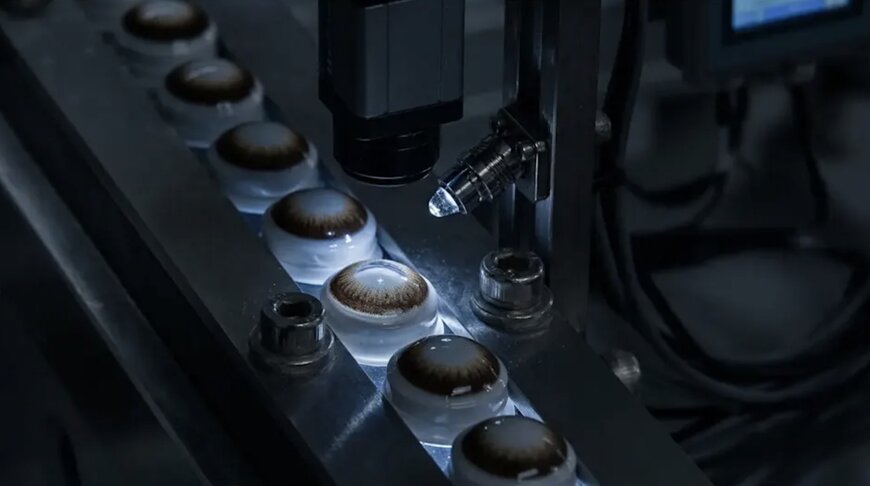
The production of daily disposable contact lenses requires zero-defect manufacturing due to their classification as medical devices. Because manual inspection cannot maintain reliability at production speeds of hundreds of units per minute, manufacturers utilize AI-powered AOI systems. This inline inspection occurs before the blister pack is sealed, while the lens is fully submerged in saline, to identify microscopic defects that could compromise patient safety or comfort.
Technical Challenges of Optical Analysis
Inspecting transparent, hydrated lenses in a liquid environment presents significant demands on sensor technology and image processing algorithms. The refractive indices of saline (~1.336) and hydrogel lenses (~1.40–1.42) are nearly identical, making the lens boundary almost invisible in conventional brightfield imaging. Key technical parameters for reliable detection include:
- Micron-Level Detection: Systems must reliably identify defects with widths of 8–20 µm and lengths of 5–100 µm.
- Resolution vs. Throughput: To ensure reliable analysis, a defect must cover at least three pixels. This requires an imaging resolution of approximately 3–5 µm per pixel using high-resolution monochrome global shutter cameras to maintain high-speed conveyor synchronization.
- Contrast Management: Low-angle darkfield illumination is utilized to scatter light only from surface and internal defects. This makes micro-tears, edge chips, and particles stand out as bright features against a black background.
AI-Driven Differentiation and Yield Optimization
A primary challenge in the automotive data ecosystem of specialized medical manufacturing is the "bubble vs. particle" dilemma. Air bubbles from the filling process often appear identical to foreign particles in darkfield images, leading to high false-reject rates. AI algorithms are trained to differentiate these visually similar features, increasing yield without compromising safety standards.
Furthermore, AI addresses the challenges of non-rigid objects. Because hydrated lenses are soft and flexible, algorithms utilize specialized edge-detection techniques to perform accurate dimensional measurements despite the physical orientation of the lens. In low-contrast conditions, Short-Wave Infrared (SWIR) imaging is increasingly considered as a technical alternative to improve material contrast.
Regulatory Compliance and Operational Benefits
The deployment of industrial vision components provides significant advantages for process stability and adherence to global regulations, such as FDA 21 CFR Part 11:
- Automated Logging: All inspection results are digitally recorded via stable interfaces like GigE Vision, ensuring full traceability and audit readiness.
- Early Defect Detection: Real-time analysis allows for the immediate identification of systematic production errors, preventing the contamination of large batches.
- Continuous Performance: Unlike manual operators, automated systems provide consistent, fatigue-free results around the clock at maximum production speeds.
This technological architecture serves as the backbone of modern contact lens facilities, where patient safety and high throughput are achieved through the synergy of precision optics, stable camera hardware, and artificial intelligence.
Explore SWIR inspection for contact lenses in blister packs
Explore SWIR inspection for contact lenses in blister packs
Edited by Romila DSilva, Induportals Editor, with AI assistance.
www.baslerweb.com

