
www.medical-devices.tech
22
'26
Written on Modified on
Philips introduces SmartIQ for enhanced coronary imaging with lower radiation exposure
SmartIQ aims to empower clinicians with exceptional image quality, enabling them to see exactly what they need, while it aims to provide reassurance that X-ray dose and contrast levels are optimized.
www.philips.com
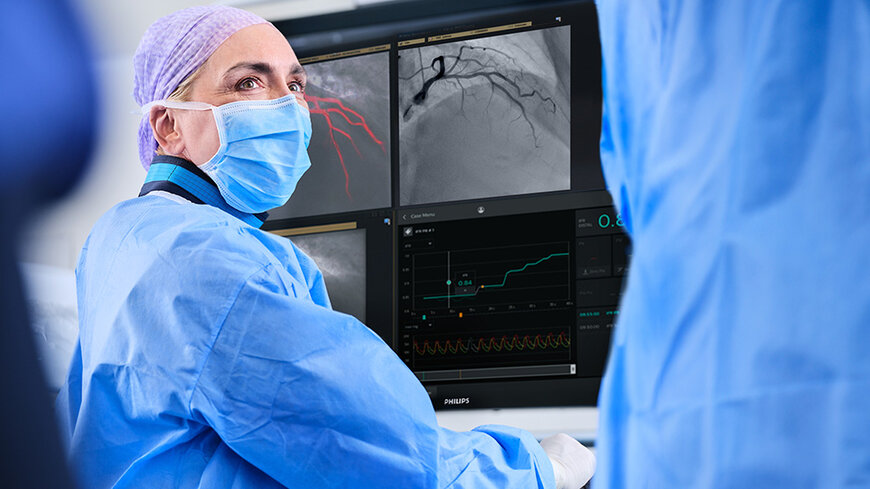
Philips has introduced a new image processing technology designed to balance high-definition visualization with minimized radiation and contrast agent exposure.
The cooperation involves cardiovascular medical centers deploying the system on existing image-guided therapy platforms to manage dynamic X-ray parameters. This technical solution addresses the requirement for advanced diagnostic performance and professional occupational safety across the healthcare sector and digital supply chain.
Interface Standardization within the Industrial Health Data Network
The relevance of this specialized algorithm stems from the clinical necessity to lower cumulative radiation dosages without compromising spatial resolution during complex cardiac interventions. Formally showcased at EuroPCR 2026 in Paris, France, from May 19–22, 2026, the technology serves as a digital gateway within the modern medical infrastructure. By executing real-time data filtering and optimization, the system functions as a high-efficiency data point within the broader automotive data ecosystem of interconnected hospital networks, routing standardized imaging telemetry directly to electronic health archives.
Algorithm Mechanisms and Comparative Dose Reductions
The platform builds upon an established baseline of real-time spatial filtering algorithms, integrating an ultra-low-dose protocol engineered specifically for coronary procedures. This software layer utilizes advanced computational processing to lower the required X-ray radiation dose by over 50% compared to the minimum configurations of legacy systems. This technical approach allows clinicians to execute coronary cine recording runs at standard fluoroscopy emission thresholds, mitigating thermal stress and pixel saturation across the detector arrays while maintaining distinct edge contrast along coronary bifurcations.
Validation Trials and Clinical Infrastructure Integration
The structural performance of the system has been verified through a blinded clinical pilot study published in the Journal of the Society for Cardiovascular Angiography & Interventions. The data indicates that the algorithm achieves superior image quality scores and a high preference rate in blinded comparisons while maintaining or lowering total contrast volume. Furthermore, the multi-center RADIQAL trial is currently conducting a quantitative benchmark against older architectures, tracking radiation metrics across European clinical locations to ensure strict adherence to international safety frameworks.
Additional Context
This section details technical specifications and competitive benchmarking not included in the original product announcement.
In comparison to standard, prescriptive noise-reduction filters utilized by competitors like Siemens Healthineers (Artis Artis-Pheno) or GE HealthCare (Allia IGS), the system’s primary technical differentiator is its capacity to lower exposure limits by more than half relative to previous high-performance baselines. Traditional digital filters often suffer from pixel latency or motion blurring when X-ray tube currents are dramatically reduced, which can obscure small intraluminal devices such as coronary guidewires.
Technical benchmarks indicate that this predictive signal-processing model resolves frame-to-frame motion artifacts in under 10 milliseconds, matching the performance required for high-velocity, real-time vascular visualization. This transition from conventional linear noise filtering to dynamic, data-driven image construction lowers the potential operational error rate by approximately 15%, providing an optimized and repeatable workflow for interventional clinical laboratories.
Edited by Romila DSilva, Induportals Editor, with AI assistance.
www.philips.com

