
www.medical-devices.tech
23
'26
Written on Modified on
Coronary Intravascular Lithotripsy Catheter Accelerates Calcium Modification
Johnson & Johnson launched the Shockwave C2 Aero Fly Coronary IVL Catheter to fracture calcified plaques and shorten procedural ischemic blockage.
www.jnjmedtech.com
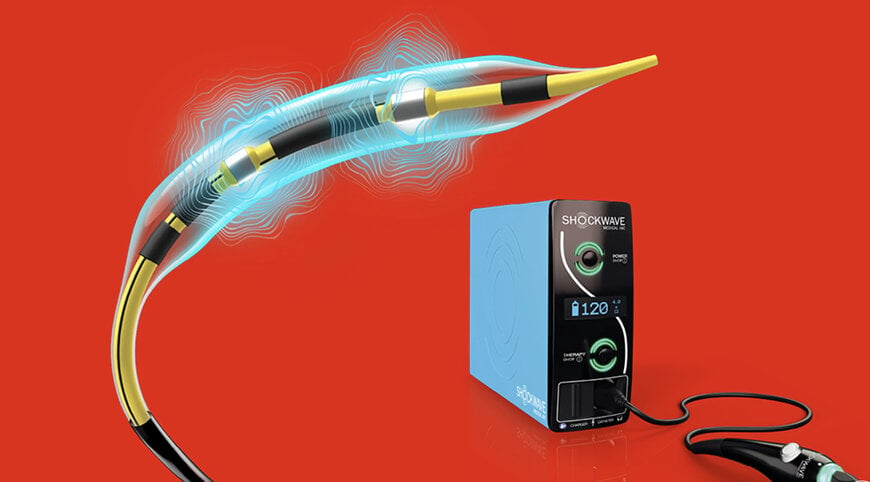
Severe arterial calcification presents a critical mechanical obstacle during percutaneous coronary interventions, as rigid calcified plaques restrict vascular compliance and prevent optimal stent expansion. Addressing this clinical and operational constraint, Johnson & Johnson introduced the Shockwave C2 Aero Fly Coronary IVL Catheter in the United States, utilizing high-frequency acoustic shockwaves to modify coronary calcium while reducing balloon inflation durations within cardiac catheterization laboratories.
Engineering Mechanics of High-Frequency Intravascular Lithotripsy
Intravascular lithotripsy modifies vascular calcification through localized, unfocused electrohydraulic acoustic pressure waves generated within an integrated balloon catheter. Once positioned across a calcified coronary lesion, the catheter balloon is expanded at low pressure with a saline-contrast mixture to establish acoustic coupling with the arterial wall. Electrical spark gaps within the catheter vaporize fluid micro-bubbles, generating transient acoustic shockwaves that propagate circumferentially. These acoustic pulses selectively crack both superficial and deep calcium deposits without disrupting surrounding elastic soft vascular tissue.
The Shockwave C2 Aero Fly architecture doubles the discharge rate from the 1 Hz frequency utilized in prior devices to 2 Hz. Increasing pulse discharge frequency cuts total active therapy delivery time from 230 seconds down to 115 seconds. In parallel, the required pause duration between sequential pulsing cycles is reduced from ten seconds to five seconds, representing a 50 percent drop in inter-cycle wait time. The catheter retains the deliverability, crossability, and repositioning mechanical profiles developed for the Shockwave C2 Aero platform, maintaining established safety and efficacy metrics while accelerating the therapy cycle.
Operational Impact on Cath Lab Workflow and Myocardial Perfusion
In interventional cardiology, balloon inflation across a coronary stenosis physically occludes coronary blood flow, inducing transient myocardial ischemia that can trigger angina, electrocardiographic shifts, and hemodynamic instability. Shortening inflation cycles and rest intervals reduces procedural ischemic time, minimizing procedure-induced ischemia and related patient discomfort such as chest pain.
Interventional cardiologist Hector Tamez Aguilar of Piedmont Healthcare noted that delivering pulses twice as fast and cutting inter-cycle intervals enables faster clinical workflows, allowing operators to treat complex calcified lesions more efficiently within high-volume catheterization facilities. Medical Director Karim Al-Azizi of the Structural Heart Program and Cardiac Catheterization Laboratories at Baylor Scott & White Health emphasized that because balloon inflation temporarily arrests coronary blood flow, lower inflation durations and reduced rest intervals directly limit patient ischemic symptoms.
Epidemiological Drivers and Upcoming Clinical Presentations
Coronary artery disease remains the leading cause of global mortality, affecting an estimated 315 million individuals worldwide and approximately 1 in 20 adults over age 20 in the United States. As patient demographics skew older and complex comorbidities such as diabetes and renal failure increase the incidence of calcified lesions, high procedural efficiency becomes necessary to manage intervention backlogs in hospital catheterization laboratories.
Johnson & Johnson MedTech plans to feature the Shockwave C2 Aero Fly Coronary IVL Catheter at the Transcatheter Cardiovascular Therapeutics conference, scheduled to take place in San Diego, California, from October 31 through November 3, 2026.
Additional Context:
This section details technical specifications and competitive benchmarking not included in the original product announcement.
Coronary plaque modification has historically relied on mechanical debulking modalities, primarily rotational atherectomy (such as the Boston Scientific ROTAPRO system) and orbital atherectomy (such as the Cardiovascular Systems Diamondback 360). These systems utilize diamond-coated burrs or crowns rotating at speeds between 140,000 and 190,000 revolutions per minute to physically ablate superficial calcium. While effective for tight, uncrossable lesions, rotational and orbital atherectomy are technically demanding and carry risks of coronary perforation, slow-flow or no-reflow phenomena due to distal microparticulate embolization, and thermal injury to the vascular wall. Furthermore, mechanical atherectomy can only ablate superficial luminal calcium and cannot modify deep intimal or medial calcium deposits without extensive vessel damage.
Intravascular lithotripsy operates under a non-abrasive acoustic fracturing mechanism, which mitigates microembolization and thermal vessel trauma. Earlier-generation devices, including the Shockwave C2 and C2+ systems, delivered up to 80 or 120 acoustic pulses in 10-pulse bursts at 1 Hz (one pulse per second), requiring 10-second rest intervals between runs to permit distal myocardial reperfusion. The advancement to 2 Hz pulse discharge and compressed five-second recovery intervals in the Shockwave C2 Aero Fly represents a significant mechanical refinement, matching the high lesion-modification efficacy of sonic pressure waves while substantially decreasing total balloon dwell time and procedure-related vascular occlusion.
Edited by Sucithra Mani, Induportals editor – adapted by AI.
www.jnjmedtech.com

