
www.medical-devices.tech
02
'26
Written on Modified on
Stryker introduces first-of-its-kind FDA-authorized surgical application for Apple Vision Pro
Stryker announced the successful completion of the first surgical procedure, a hip arthroscopy, using SportSuite Vision on Apple Vision Pro at a leading academic medical center.
www.stryker.com
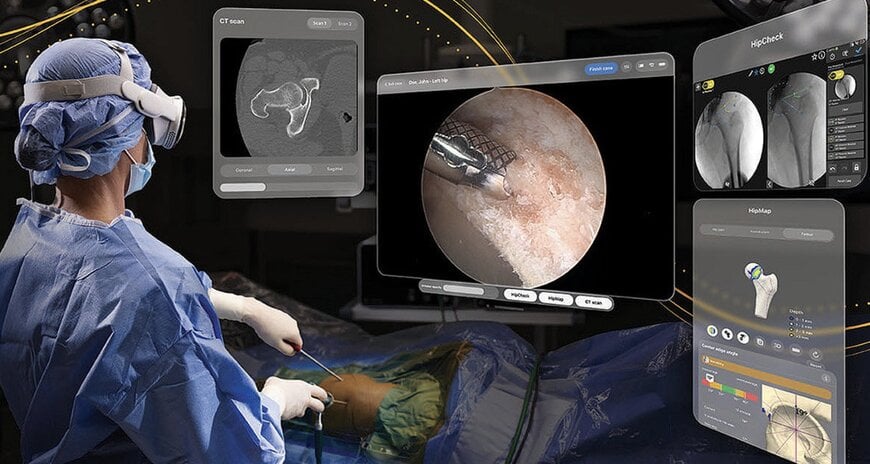
Stryker announced that an orthopedic surgical team at Duke Health has completed the first hip arthroscopy procedure using SportSuite Vision running on Apple Vision Pro. The platform received FDA De Novo authorization on July 17, establishing it as the first application cleared by the agency for intraoperative use with Apple's spatial computing headset.
Intraoperative Spatial Computing and Workflow Ergonomics
Arthroscopic procedures traditionally require surgical teams to monitor multiple physical screens positioned across the operating theater to review endoscopic camera feeds, anatomical models, and patient scans. SportSuite Vision projects these digital data streams directly into the surgeon's visual field while maintaining full visibility of the sterile field and physical surroundings:
- Consolidated Data Feeds: Aggregates intraoperative arthroscopic camera video feeds alongside preoperative CT scans and Stryker's proprietary HipCheck and HipMap digital guidance tools into customizable floating viewports.
- Ergonomic OR Configuration: Reduces physical clutter and dependency on stationary external displays, minimizing head turning and awkward body positioning during complex joint interventions.
- Sterile Field Accessibility: Enables surgeons to position and interact with patient clinical telemetry and anatomical templates directly within their line of sight without breaking the sterile barrier.
Additional Context
This section details technical specifications not included in the original news release.
Medical-grade spatial computing platforms rely on ultra-low-latency sensor-to-display pipelines to prevent motion sickness and vestibular mismatch during precision micro-manipulation. The underlying headset hardware architecture utilizes dual micro-OLED displays delivering high pixel densities exceeding 3,000 pixels per inch, rendering stereoscopic digital overlays with sub-millimeter registration accuracy. Video pass-through pipelines combine high-resolution stereoscopic RGB camera streams processed through dedicated real-time vision coprocessors, achieving photon-to-motion latencies under 12 milliseconds to maintain real-time hand-eye coordination during surgical instrument tracking.
Medical software applications cleared under the FDA De Novo regulatory pathway undergo rigorous cybersecurity, electromagnetic compatibility (EMC), and human factors evaluations conforming to IEC 60601-1-2 and IEC 62304 standards for medical device software life cycle processes. Video data links between the surgical endoscopy tower, PACS imaging servers, and the wearable spatial headset are transmitted over high-throughput, low-latency enterprise Wi-Fi 6E or dedicated ultra-wideband (UWB) wireless networks using TLS 1.3 cryptographic protocols. Real-time eye-tracking and gesture-recognition sensors allow hands-free user interface navigation, mapping cornea-reflected infrared LED patterns and depth-sensor pinch inputs to ensure aseptic control without physical device contact.
Edited by Romila DSilva, Induportals Editor, with AI assistance.
This section details technical specifications not included in the original news release.
Medical-grade spatial computing platforms rely on ultra-low-latency sensor-to-display pipelines to prevent motion sickness and vestibular mismatch during precision micro-manipulation. The underlying headset hardware architecture utilizes dual micro-OLED displays delivering high pixel densities exceeding 3,000 pixels per inch, rendering stereoscopic digital overlays with sub-millimeter registration accuracy. Video pass-through pipelines combine high-resolution stereoscopic RGB camera streams processed through dedicated real-time vision coprocessors, achieving photon-to-motion latencies under 12 milliseconds to maintain real-time hand-eye coordination during surgical instrument tracking.
Medical software applications cleared under the FDA De Novo regulatory pathway undergo rigorous cybersecurity, electromagnetic compatibility (EMC), and human factors evaluations conforming to IEC 60601-1-2 and IEC 62304 standards for medical device software life cycle processes. Video data links between the surgical endoscopy tower, PACS imaging servers, and the wearable spatial headset are transmitted over high-throughput, low-latency enterprise Wi-Fi 6E or dedicated ultra-wideband (UWB) wireless networks using TLS 1.3 cryptographic protocols. Real-time eye-tracking and gesture-recognition sensors allow hands-free user interface navigation, mapping cornea-reflected infrared LED patterns and depth-sensor pinch inputs to ensure aseptic control without physical device contact.
Edited by Romila DSilva, Induportals Editor, with AI assistance.

