
www.medical-devices.tech
18
'26
Written on Modified on
Robotic Bronchoscopy Software Advances Lung Nodule Navigation
Johnson & Johnson has introduced MONARCH QUEST 3, a software update for its MONARCH Platform that adds AI-assisted planning, navigation enhancements, 3D orientation and broader imaging compatibility for bronchoscopic lung nodule procedures.
www.jnjmedtech.com
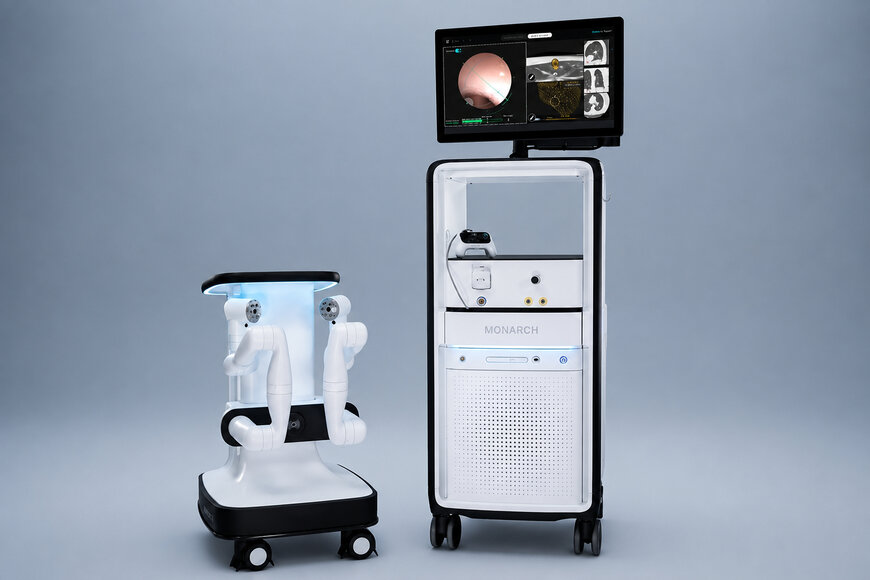
The update is intended for diagnostic and therapeutic bronchoscopic procedures involving the airways, with particular relevance to the navigation and biopsy of peripheral lung nodules. Johnson & Johnson announced U.S. 510(k) clearance for MONARCH QUEST 3 on August 17, 2026.
The software addresses a technical challenge in robotic bronchoscopy known as CT-to-body divergence. This occurs when the position of a lung nodule during a procedure differs from its position on the pre-procedural CT scan because of changes in anatomy, respiration and other procedural conditions.
MONARCH QUEST 3 adds AI-powered nodule segmentation that is designed to generate nodule boundaries automatically during pre-procedural planning. The company also reports software changes intended to improve registration and navigation accuracy as anatomy changes during bronchoscopy.
These capabilities are relevant to procedures in which physicians use CT-derived anatomical information to plan a route to a pulmonary lesion before navigating a flexible robotic bronchoscope through the airway.
3D Navigation and Scope-Tip Orientation
A new 3D Compass overlay is designed to provide a visual relationship between joystick controls and patient anatomy. The feature is intended to help clinicians understand scope-tip orientation during navigation.
The update also maintains continuous registration and real-time tracking of the scope tip relative to patient anatomy, according to Johnson & Johnson. The objective is to keep navigation information aligned with the patient's anatomy throughout the procedure rather than relying solely on the original CT-based plan.
The MONARCH Platform combines robotic control with bronchoscopic visualization, allowing clinicians to navigate and biopsy targets under direct vision. Its flexible robotic bronchoscope provides controlled positioning and stability during access to the lung periphery.
Cone-Beam CT Integration for CT-to-Body Divergence
MONARCH QUEST 3 expands compatibility with mobile and fixed cone-beam computed tomography systems. This allows hospitals with compatible imaging infrastructure to use intraprocedural imaging as part of the navigation and targeting workflow.
The approach is significant because cone-beam CT can provide three-dimensional information during a procedure, allowing the target position to be reassessed after the patient has been positioned and the lungs are being ventilated.
Comparable robotic bronchoscopy platforms have adopted similar intraprocedural imaging strategies. Intuitive's Ion system, for example, integrates cone-beam CT and tomosynthesis options that can be used to update target locations and verify tool-in-lesion positioning.
Noah Medical's Galaxy System combines electromagnetic navigation with digital tomosynthesis and augmented fluoroscopy. Published experimental work has evaluated the system's ability to confirm tool-in-lesion positioning using intraprocedural imaging.
The growing use of these imaging approaches reflects a broader shift in robotic bronchoscopy from navigation based primarily on pre-procedural CT data toward workflows that can incorporate updated anatomical information during biopsy.
Digital Procedural Data and Case Review
The software release also incorporates capabilities from Polyphonic, Johnson & Johnson's open digital ecosystem. Polyphonic for MONARCH organizes procedural cases into a standardized, reviewable format and provides a centralized video library.
The system is intended to allow clinicians to review procedural volume data, revisit cases and collaborate with other teams. This extends the role of digital technology beyond navigation itself by creating a structured source of procedural information for education, case review and workflow analysis.
For clinical teams, such data infrastructure can complement navigation software by making procedural video and case information easier to access consistently across procedures.
Software-Based Development of Robotic Bronchoscopy
MONARCH QUEST 3 represents a software-led development of the MONARCH Platform rather than a new robotic bronchoscopy system. Johnson & Johnson describes the platform as a flexible, robotically assisted bronchoscopy system designed to evolve through successive hardware and software updates.
The release follows three MONARCH Platform launches during the preceding 18 months, according to the company. Its development focuses on three connected areas: pre-procedural planning, intraprocedural navigation and target localization.
These areas are increasingly important as robotic bronchoscopy expands toward smaller and more peripheral pulmonary lesions, where the difference between a pre-procedural CT roadmap and the patient's anatomy during biopsy can affect navigation and targeting.
Additional Context:
This section details technical specifications and competitive benchmarking not included in the original product announcement
Robotic bronchoscopy systems generally use one of several navigation and localization approaches, including electromagnetic navigation, fiber-optic shape sensing and intraprocedural imaging. The technologies differ in how they establish catheter position and how they compensate for changes between pre-procedural imaging and the procedure.
Intuitive's Ion system uses fiber-optic shape sensing to measure the catheter's location, shape and orientation continuously. The company's current system combines this approach with advanced imaging options for target updates and tool-in-lesion verification.
Noah Medical's Galaxy System uses electromagnetic navigation and integrates digital tomosynthesis with augmented fluoroscopy to address CT-to-body divergence. A peer-reviewed MATCH study evaluated tool-in-lesion accuracy using simulated lung nodules and cone-beam CT as the reference for lesion and tool position.
A 2024 review of robotic-assisted bronchoscopy technologies identified electromagnetic navigation, shape sensing and intraprocedural imaging as distinct approaches used across commercially available systems. The review also noted that target-location updating is becoming an important mechanism for addressing CT-to-body divergence.
Against this technical background, MONARCH QUEST 3's combination of AI-assisted nodule segmentation, navigation software, 3D orientation and compatibility with mobile and fixed CBCT systems places the update within the broader industry movement toward continuously updated lung navigation rather than navigation based exclusively on a static CT roadmap.
Edited by Sucithra Mani, editora de Induportals – adaptado por IA.
www.jnjmedtech.com

