
www.medical-devices.tech
07
'26
Written on Modified on
Compact Ultrasound Systems Add AI-Assisted Imaging Tools
GE HealthCare expands its portable ultrasound platform with two laptop-sized systems combining AI-assisted acquisition, workflow automation and multi-specialty imaging capabilities.
www.gehealthcare.com
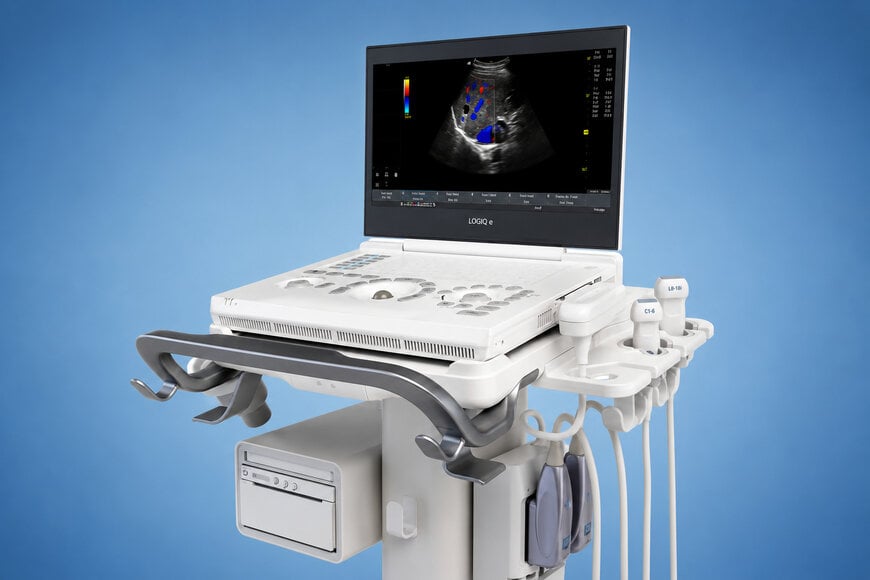
GE HealthCare has introduced two compact ultrasound configurations designed to extend diagnostic imaging beyond conventional imaging departments and into clinical environments including emergency medicine, critical care, anesthesiology, rheumatology and musculoskeletal care.
The LOGIQ e X and LOGIQ e S systems build on the existing LOGIQ e platform, combining laptop-sized hardware with imaging and workflow functions intended for clinicians who need to move ultrasound equipment between examination rooms and care settings. Both systems have received U.S. Food and Drug Administration 510(k) clearance and CE marking, with availability in additional markets subject to local regulatory approval.
Portable Imaging Across Multiple Clinical Applications
The two configurations address different clinical and operational requirements. LOGIQ e X is the higher-feature configuration, incorporating AI-assisted tools, advanced imaging functions and workflow automation. LOGIQ e S provides the platform's essential imaging capabilities in a simplified configuration.
Both are intended for professional healthcare facilities and support multi-purpose ultrasound examinations as well as musculoskeletal imaging, emergency medicine, critical care, rheumatology and anesthesiology.
The platform reflects the increasing use of portable ultrasound outside dedicated radiology departments, where equipment size and workflow can affect how readily imaging can be integrated into bedside procedures and examinations.
AI-Assisted Ultrasound Acquisition and Anatomy Identification
LOGIQ e X incorporates AI-assisted functions intended to reduce some of the manual steps associated with ultrasound acquisition and anatomical identification.
Nerveblox labels anatomical landmarks directly within ultrasound images. The function is designed to assist clinicians in identifying structures during peripheral nerve block procedures, where ultrasound is used to locate nerves and surrounding anatomy before needle placement.
MSK Go applies automated anatomical identification to musculoskeletal ultrasound. It assists clinicians in recognizing anatomical structures in acquired images, providing guidance during examinations of muscles, tendons, joints and related structures.
These functions are available on LOGIQ e X, with availability dependent on product configuration and geographic market.
Workflow Automation Reduces Manual System Interaction
The platform also incorporates Scan Assistant and Voice Control. Scan Assistant, available on LOGIQ e X, automates selected examination workflow steps, while voice operation can reduce the need for physical interaction with system controls during scanning.
Such functions are particularly relevant when the clinician performing the procedure is also operating the ultrasound system, as occurs frequently in anesthesiology, emergency medicine and point-of-care ultrasound.
Automating repetitive system interactions can allow operators to concentrate on probe positioning, image interpretation and the procedure rather than repeatedly returning to the control interface.
Blood Flow, Tissue and Cardiac Imaging Functions
Several imaging modes extend the platform beyond conventional B-mode ultrasound.
B-Flow provides real-time visualization of blood flow using high-resolution imaging. Unlike conventional color Doppler displays, the technique is intended to visualize blood echoes directly, providing additional information about vascular flow and vessel anatomy.
Speckle Reduction Imaging HD processes ultrasound images to reduce speckle-related image noise while maintaining tissue information, improving contrast between organs, lesions and surrounding structures.
Automated Function Imaging, available on LOGIQ e X, evaluates structural and functional characteristics of the left ventricle, right ventricle and left atrium across the cardiac cycle.
For obstetric examinations, SonoBiometry automates measurements of the fetal head, abdomen and femur. Automating these measurements reduces the number of manual control inputs required during fetal biometry examinations.
Wireless Probe Compatibility Extends Scanning Flexibility
LOGIQ e X also supports compatibility with GE HealthCare's Vscan Air wireless ultrasound probes.
The cable-free probe architecture provides another scanning configuration for applications where probe cables could restrict positioning or equipment movement. This can be useful during bedside examinations and procedures where clinicians need to reposition equipment around the patient.
The laptop system therefore functions as part of a broader portable ultrasound environment rather than solely as a standalone imaging device.
Cloud-Based Ultrasound Fleet Management
Depending on configuration and geographic availability, the systems can connect with GE HealthCare's Verisound digital tools.
Verisound Fleet provides cloud-based fleet management for healthcare organizations operating multiple ultrasound systems. Functions include remote system configuration, backup and deployment of settings across multiple devices.
This approach can help standardize configurations across an ultrasound fleet rather than requiring technicians to configure each device individually.
Verisound Collab adds virtual collaboration and real-time system-use collaboration, allowing clinicians within an organization's network to communicate while ultrasound systems are being used. The collaboration capability is not intended for diagnostic use.
The combination of portable hardware and centralized digital management addresses a practical issue created when ultrasound systems become distributed across departments: maintaining consistent configurations and supporting users across multiple locations.
Regulatory Status and Availability
Both ultrasound systems have received 510(k) clearance in the United States and carry CE marking. They are also available in other markets where the necessary regulatory approvals have been obtained.
Feature availability varies according to system configuration and region. AI-assisted capabilities including Scan Assistant, Nerveblox, MSK Go and Automated Function Imaging are associated with the LOGIQ e X configuration, while some digital services are also dependent on regional availability.
Additional Context:
This section details technical specifications and competitive benchmarking not included in the original product announcement
Portable laptop-style ultrasound represents an established category between handheld ultrasound probes and larger cart-based diagnostic systems. Systems in this class are designed to provide broader imaging functionality than highly compact handheld devices while remaining transportable between clinical environments.
For comparison, Siemens Healthineers specifies its ACUSON P500 portable ultrasound system at 7.2 kg including the battery, with a 15.4-inch high-resolution LCD display, approximately one hour of scanning under battery power and support for three active transducer ports. The system is specified to be ready for scanning in less than 30 seconds.
Philips positions its Compact 5500 series within the compact ultrasound category. The Compact 5500CV configuration is specified at 10.57 kg including its internal battery and uses a 15.6-inch 1920 × 1080 LCD display. Its compact chassis measures approximately 41.1 cm wide, 40.6 cm deep and 8.6 cm high.
These specifications illustrate the physical range of laptop and compact ultrasound systems, but a direct weight, battery-life or display-size comparison with the new GE HealthCare systems cannot yet be made from the announcement because GE HealthCare did not provide corresponding numerical hardware specifications.
The differentiating information disclosed for LOGIQ e X instead centers on software-assisted workflow and image acquisition, including anatomical labeling for nerve-block procedures, musculoskeletal structure identification, automated fetal measurements, cardiac analysis, voice operation and compatibility with wireless probes.
Edited by Sucithra Mani, Induportals editor – adapted by AI.
www.gehealthcare.com

