
www.medical-devices.tech
22
'26
Written on Modified on
Fiber Laser System for Urological Lithotripsy
BD introduces a thulium fiber laser system designed for kidney stone and soft tissue procedures in urology.
www.bd.com
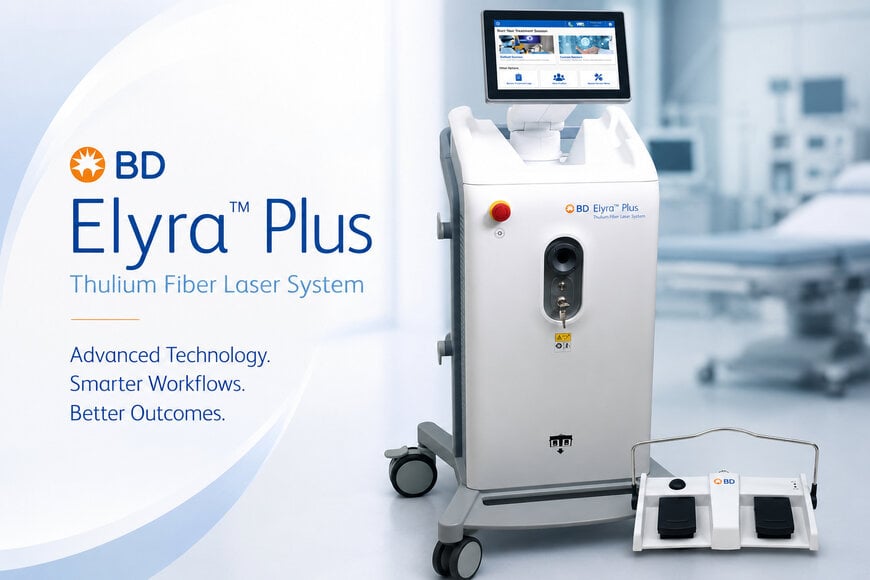
BD (Becton, Dickinson and Company) announced the launch of the Elyra thulium fiber laser system for urology teams performing lithotripsy and soft tissue procedures. The platform expands the company’s kidney stone management portfolio and is intended to improve procedural efficiency, clinical versatility, and integration into hospital workflows.
The system uses thulium fiber laser (TFL) technology, an approach increasingly adopted in endourology because of its ability to deliver low-energy, high-frequency pulses. This architecture supports efficient stone dusting while reducing stone migration during procedures.
TFL Technology for Kidney Stone Management
The Elyra platform is available in two configurations, Elyra and Elyra Plus, to address different operational requirements in urology departments. The Elyra Plus version includes an optional wireless footswitch designed to simplify system control during procedures.
BD states that the platform features an air-cooled design that enables quieter operation and a smaller footprint compared with conventional lithotripsy laser systems. This configuration can support easier installation in space-constrained operating rooms while reducing maintenance requirements associated with water-cooled systems.
The user interface was developed to improve procedural preparation through fast startup, customizable presets, and simplified navigation. These functions are intended to reduce workflow interruptions and improve continuity during urinary stone fragmentation procedures.
Workflow Optimization in Interventional Urology
The system is designed for kidney stone treatment, ureteral stone fragmentation, and selected soft tissue interventions performed through endoscopic approaches. Thulium fiber lasers are increasingly used in flexible lithotripsy procedures requiring high precision and reduced retropulsion of stone fragments.
According to Mike Cusack, worldwide president of Urology and Critical Care at BD, the platform combines advanced TFL technology with a clinician-focused design intended to improve efficiency in kidney stone care.
BD reported that the first clinical procedures using the Elyra Plus system were completed at a U.S. medical center. Feedback from urologists and laser technicians highlighted the interface usability and integrated safety features that supported confidence during procedures.
Expansion of the Urological Stone Management Portfolio
The Elyra launch forms part of BD’s strategy to provide an integrated portfolio for urological stone management. The portfolio includes solutions for access, dilation, visualization, fragmentation, removal, and drainage procedures.
The addition of a proprietary laser platform also allows BD to accelerate future product development in response to evolving clinical requirements and procedural trends in endourology.
The Elyra and Elyra Plus systems are currently available in the United States.
Additional Context: Technical Specifications and Competitive Benchmarking
Thulium fiber lasers typically operate at a wavelength near 1940 nm, which is strongly absorbed by water and supports efficient stone vaporization and fragmentation. Compared with conventional Holmium:YAG laser systems historically used in lithotripsy, TFL systems can deliver higher pulse frequencies and operate with smaller-diameter laser fibers.
Comparable TFL platforms are also available from manufacturers including Olympus, Quanta System, and Coloplast. Benchmarking criteria in this segment generally include maximum power output, pulse frequency range, cooling architecture, compatible fiber sizes, and software integration for procedural workflow management.
TFL systems are commonly evaluated for their ability to reduce stone retropulsion, improve fragmentation efficiency, and minimize procedural interruptions. Multiple clinical studies have also reported potential reductions in operative time for selected flexible lithotripsy procedures compared with conventional Holmium laser platforms.
Edited by Sucithra Mani, Induportals editor – adapted by AI.
www.bd.com

