
www.medical-devices.tech
13
'26
Written on Modified on
Automated dissolution testing improves pharmaceutical lab workflows
Erweka outlines how integrated testing platforms support data integrity, regulatory compliance and continuous operation in pharmaceutical QC and R&D laboratories.
www.erweka.com

Pharmaceutical laboratories operate under increasing pressure to improve throughput while maintaining strict compliance with regulatory and pharmacopeial standards. Dissolution testing determines how active pharmaceutical ingredients are released under defined conditions, making it a critical step in quality assurance and product validation.
Despite high levels of automation in pharmaceutical manufacturing, dissolution testing workflows often remain partially manual. Manual sampling, paper-based documentation, shift transitions and disconnected data systems can introduce variability and delays while increasing documentation risk. A fully automated dissolution laboratory addresses these constraints through integrated workflows designed to support reproducibility, data traceability and continuous testing capacity.
Connecting instruments into a unified testing architecture
Dissolution testing typically includes media preparation, apparatus setup, sample loading, timed sampling, filtration, analytical transfer and cleaning. In conventional laboratory setups, these tasks are often performed using separate instruments and manual handovers, increasing the potential for delays or transcription errors.
Automated environments integrate dissolution testers, automated sampling units, fraction collectors or direct injection systems, and UV–Vis or HPLC analysis through centralised software control. Process parameters such as temperature, agitation speed and sampling intervals are recorded automatically, while analytical data is transferred directly into reporting systems.
More advanced configurations can incorporate robotic handling systems to manage vessel preparation, testing sequences and cleaning cycles. This approach reduces operator intervention and supports consistent process execution, improving repeatability and overall process control.
Toward continuous laboratory operation
Highly automated environments can support extended or continuous operation with minimal operator interaction. Analysts typically prepare test methods and samples, after which automated systems execute time-dependent tasks. This approach allows testing to continue beyond standard working hours, supporting higher laboratory utilisation.
Automation is also used to address skills shortages and increasing documentation workloads. Dissolution tests often run for extended periods, sometimes beyond a single work shift. Manual handovers between operators may introduce documentation burdens and process deviations, while manual sampling techniques can introduce variability linked to operator handling.
Automated sampling systems execute defined procedures consistently, supporting reproducibility and reducing risks associated with manual variability. In this context, automation contributes to both operational efficiency and risk reduction.
Phased automation strategies for laboratory upgrades
Laboratories typically implement automation in stages rather than through complete replacement of existing systems. A phased approach may begin with standalone dissolution testers, followed by automated sampling modules and integration with UV–Vis or HPLC analytical instruments.
Further upgrades may include additional pumps, fraction collectors and expanded software capabilities. This modular strategy allows laboratories to scale automation according to throughput needs and budget constraints while preserving initial capital investments. Such scalability also supports long-term laboratory planning by allowing systems to expand without requiring replacement of core equipment.
Throughput gains and financial justification
Automation strategies are often evaluated based on both operational and financial factors. Continuous operation capability can support faster testing cycles and reduce bottlenecks between production and quality control, allowing earlier batch release and improved inventory turnover.
Return on investment calculations typically consider labour requirements, retesting frequency, documentation effort and equipment utilisation. Depending on testing volumes and operational structure, some laboratories report payback periods of less than two years.
Automation also improves consistency by reducing operator-dependent errors such as incorrect sampling timing or inconsistent media preparation. While the financial impact of testing errors varies, failed batch releases, investigations and retesting can introduce significant indirect costs.
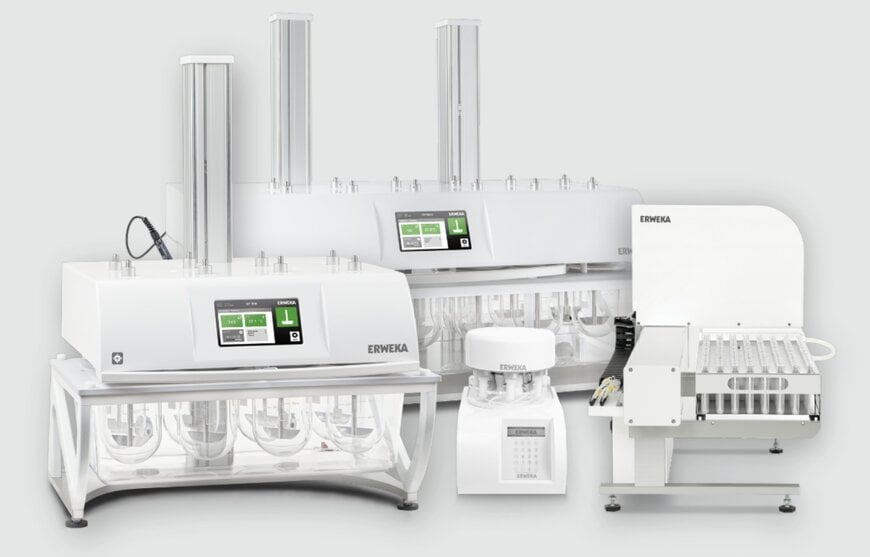
Scalable automation platforms for pharmaceutical laboratories
Erweka structures its dissolution testing portfolio around modular integration and upgradeability. The company provides pharmacopeia-compliant dissolution testers supporting commonly used USP Apparatus 1 and 2 methods, as well as the broader USP Apparatus 1 through 7 range for applications including transdermal delivery systems and specialised dosage forms.
Systems can be configured with automated sampling, offline fraction collection or online integration with UV–Vis and HPLC instruments. In advanced configurations, dissolution samples can be transferred directly into HPLC analytical workflows, reducing manual transfer steps.
Software usability, audit trail capabilities and mechanical robustness remain important selection criteria in regulated environments where pharmacopeial requirements already define core performance parameters. Differentiation, therefore, often depends on integration capability, usability and support for progressive automation strategies.
Digital integration shaping the next phase of dissolution testing
Laboratories are expected to continue prioritising automation and data integrity as regulatory expectations and development complexity increase. Continuous operation models and digital integration between analytical instruments and enterprise platforms are becoming part of laboratory modernisation strategies.
For QC and R&D environments balancing regulatory requirements with cost pressures, automated dissolution testing represents a gradual transition rather than a single investment step, supported by modular system architectures and integrated laboratory data environments.
Edited by industrial journalist, Aishwarya Mambet — AI-powered.
www.erweka.com

