
www.medical-devices.tech
16
'26
Written on Modified on
Medtronic Advances Spine Robotics With Real-Time Segmental Tracking
FDA-cleared integrated platform combines surgical planning, navigation, and modular robotics while enabling continuous intraoperative visualization of spinal motion.
www.medtronic.com
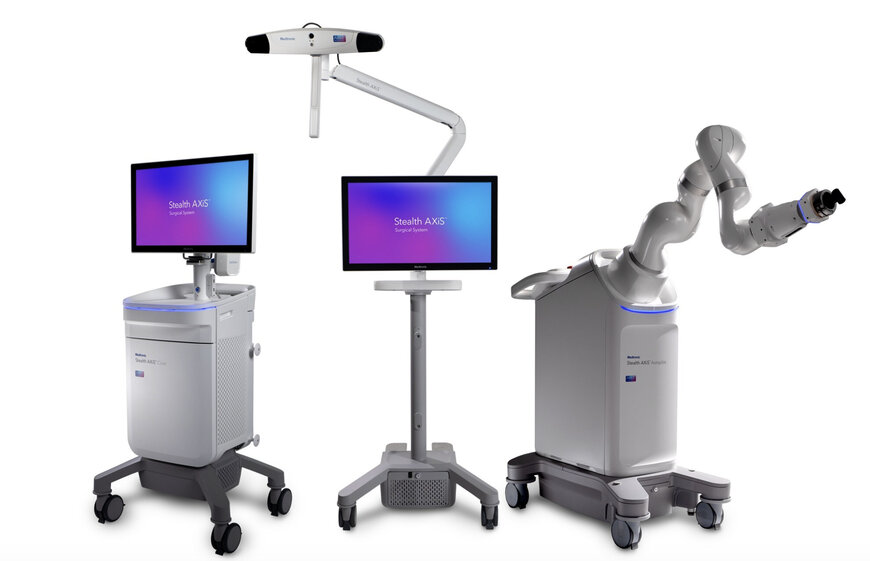
Applications in Spine Surgery Across Hospitals and Ambulatory Centers
For orthopedic and neurosurgical spine procedures performed in hospitals and ambulatory surgery centers, maintaining alignment accuracy during instrumentation remains a technical challenge, particularly when spinal segments move intraoperatively. Medtronic has received U.S. Food and Drug Administration (FDA) clearance for its Stealth AXiS surgical system, a spine robotics platform that integrates surgical planning, navigation, and robotic assistance within a single architecture.
The system is cleared for spine procedures in the United States. Its core architecture has also been designed to support potential future cranial and ENT applications, subject to additional 510(k) clearance.
What Changes With an Integrated Spine Robotics Platform?
Conventional spine surgery workflows often rely on separate systems for preoperative planning, intraoperative navigation, and robotic guidance. These technologies may operate on different interfaces, requiring data transfers and manual verification steps during surgery.
The Stealth AXiS system consolidates these functions into a unified platform. Planning data generated preoperatively flows directly into intraoperative navigation and robotic execution without requiring external bridging between standalone technologies. This integration is intended to streamline workflow and reduce interruptions during instrumentation placement.
The robotic component is modular, allowing institutions to deploy navigation capabilities initially and expand to robotic assistance as clinical needs evolve. This phased approach may support adoption in facilities with varying procedure volumes and infrastructure constraints.
Live Segmental Tracking Without Repeated Imaging
A central technical development of the platform is LiveAlign segmental tracking, which enables real-time visualization of spinal motion and alignment changes during surgery.
In procedures such as multilevel fusion or deformity correction, spinal segments can shift after decompression or implant placement. Traditional navigation-assisted surgery may require repeated intraoperative imaging to verify accuracy following such movement. Live segmental tracking provides continuous visualization of anatomical motion without the need for additional imaging acquisitions.
According to Ronald A. Lehman, Jr., M.D., Professor of Orthopaedic Surgery at Columbia University and Spine Medical Director at The Spine Hospital at NewYork-Presbyterian/The Allen Hospital, the system offers “real-time visibility into that motion,” helping surgeons execute their surgical plan without interrupting workflow.
For surgeons managing complex alignment cases, this capability addresses a known source of variability in spine robotics: maintaining plan fidelity as anatomy changes intraoperatively.
Positioning Within the Spine Robotics Market
The spine robotics segment includes established platforms from companies such as Globus Medical and Zimmer Biomet, which integrate navigation and robotic assistance for pedicle screw placement and spinal instrumentation.
While competing systems provide image-guided robotic support, continuous segment-level motion tracking without repeated imaging is not a standard feature across all platforms. The distinguishing technical element of the Stealth AXiS system lies in its combination of real-time segmental tracking and single-architecture integration of planning, navigation, and robotics.
No comparative clinical performance data, such as screw placement accuracy rates or reductions in radiation exposure, were disclosed in the clearance announcement.
Integration Across the Surgical Continuum
The system is designed to function within a connected digital ecosystem, enabling information exchange before, during, and after spine surgery. By integrating planning, navigation, and execution within one platform, the system supports continuity of data across the surgical workflow.
For healthcare institutions, this architecture may contribute to workflow standardization and reduced reliance on multiple user interfaces. For surgeons, real-time motion tracking and unified data integration may support more consistent alignment execution in complex spine procedures.
With FDA clearance secured for spine surgery in the United States, the Stealth AXiS surgical system expands the range of integrated spine robotics platforms available to facilities seeking unified surgical navigation and robotic assistance technologies.
www.medtronic.com

