

www.medical-devices.tech
12
'26
Written on
Modified on
EBM Papst News
ebm-papst presents medical ventilation solutions & retrofits at COMPAMED 2026
AxiForce axial fans, RVE45 radial fans and EC-based FanGrid retrofits target quieter operation, reliable cooling and improved hospital ventilation efficiency.
www.ebmpapst.com
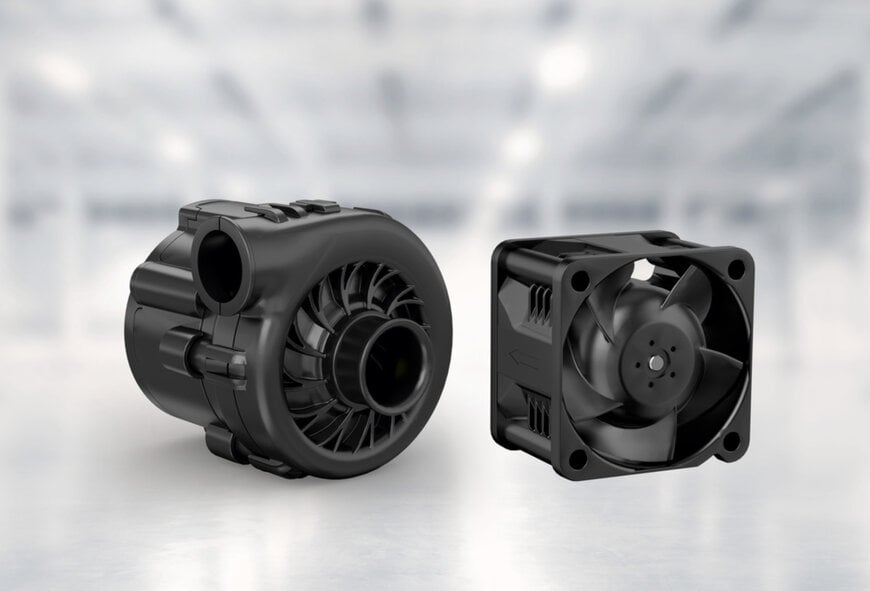
Thermal regulation and precise airflow delivery present critical engineering challenges in diagnostic imaging, life-support hardware, and clinical facility HVAC systems. To address these demands, ebm‑papst will present integrated air movement solutions, including the AxiForce axial fan series, the RVE45 radial blower, and modular FanGrid retrofit architectures, at Compamed in Düsseldorf from November 16 to 19, 2026.
Engineering Challenges in Medical Device Thermal Management
Modern medical technology imposes conflicting design constraints on fluid dynamics and heat dissipation. Equipment such as computed tomography (CT) scanners, magnetic resonance imaging (MRI) units, mammography machines, and automated laboratory analyzers generate elevated localized heat flux from high-density power electronics and gradient amplifiers. Dissipating this thermal load requires substantial volumetric airflow against high system backpressure. However, clinical environments require stringent acoustic containment to prevent patient distress and maintain communicative clarity for medical personnel.
Component-level thermal solutions often fail when aerodynamic profiles are designed independently of electronic drive control. Turbulent flow across fan blades generates narrowband acoustic peaks and broadband noise, while motor cogging torque introduces mechanical vibrations that can distort precision imaging equipment. Meeting these operational demands requires aerodynamic blade geometry, brushless motor engineering, and intelligent commutation integrated into a single mechatronic assembly.
Aerodynamic Optimization and Acoustic Attenuation in Axial Systems
At Compamed, located in Hall 8A at Booth D02, ebm‑papst demonstrates its mechatronic approach through the AxiForce series of compact axial fans. Designed for space-constrained electronics cooling, the series addresses elevated backpressure profiles typical of densely packed medical device architectures.
The engineering design combines aerodynamically profiled impellers with stationary housing guide vanes that convert residual dynamic swirl into static pressure. By smoothing the velocity profile of exhaust air and minimizing separation bubbles at the blade tips, the assembly mitigates aerodynamic turbulence. Integrated drive electronics utilize pulse-width modulation (PWM) and tachometer feedback loops to match impeller velocity directly to real-time temperature gradients, cutting parasitic power consumption and keeping acoustic output low during partial-load diagnostic routines.
Dynamic Pressure Generation in Respiratory and Life-Support Equipment
While diagnostic imaging demands steady-state thermal evacuation, critical care applications such as mechanical ventilators and alternating-pressure therapeutic mattresses require dynamic mass flow and rapid transient pressure control. Ventilator blowers must deliver precise tidal volumes and transition rapidly between positive end-expiratory pressure (PEEP) and peak inspiratory pressure (PIP) to match natural patient breathing cycles.
To address these requirements, ebm‑papst developed the RVE45 radial blower. Featuring an ultralow-inertia rotor and an electronically commutated motor with integrated sensorless control, the blower accelerates and decelerates rapidly to provide fast response times under changing fluid resistance. Its fluid path is aerodynamically contoured within a compact scroll housing, preventing pressure stalling and minimizing flow separation. The enclosed assembly delivers quiet continuous operation, which is essential for bedside life-support devices and sleep therapy systems operating in close proximity to the patient.
Modernizing Hospital HVAC Infrastructure Through EC FanGrid Retrofits
Beyond standalone medical devices, medical facilities face strict regulatory requirements regarding ambient air changes, pathogen containment, and continuous operation in critical areas such as operating suites and intensive care units. Traditional hospital air handling units (AHUs) frequently rely on legacy, belt-driven centrifugal fans driven by conventional AC induction motors. These systems present single-point-of-failure vulnerabilities, generate particulate contamination via mechanical belt wear, and suffer from low electrical efficiency at partial loads.
To modernize existing technical building infrastructure without replacing entire air handling cabinets, ebm‑papst provides modular retrofit architectures based on electronically commutated (EC) fans configured in a FanGrid arrangement. By replacing a single large belt-driven blower with a parallel wall of direct-drive EC centrifugal fans, the system distributes airflow uniformly across filter banks, lowering face velocity and reducing filter pressure drops.
The parallel array architecture incorporates built-in operational redundancy (N+1 engineering). If an individual fan encounters an operational fault, the remaining units automatically modulate their rotational speed via continuous bus communication to preserve required static pressure and volumetric flow rates, maintaining sterile air pressure cascades without emergency shutdowns.
Additional Context:
This section details technical specifications and competitive benchmarking not included in the original product announcement.
Operating data for the ebm‑papst AxiForce series shows performance envelopes suited for high-density cooling, available in frame dimensions including 80 mm and 120 mm. Across comparable operating points, the aerodynamic blade design and stator guide vanes achieve acoustic reductions of up to 6 dB(A) compared to previous-generation compact fans. The drive units operate across standard industrial DC voltages (12, 24, and 48 V DC) and can be configured with environmental protection ratings up to IP68 for equipment subjected to intensive chemical washdown and automated disinfection procedures.
The RVE45 radial blower has an outer envelope of roughly 65 mm by 65 mm by 64 mm and operates at rotational speeds reaching 40,000 rpm on a 24 V DC supply. This design generates static pressures exceeding 5,000 Pa, with dynamic step responses capable of transitioning between baseline and peak pressures in under 100 milliseconds. This performance matches the dynamic response criteria specified in modern high-flow therapy and non-invasive ventilation (NIV) devices.
When benchmarked against legacy single-fan centrifugal belt-driven units commonly found in aging hospital air handling units, direct-drive EC FanGrid arrays eliminate mechanical transmission losses from pulleys and belts, yielding continuous electrical efficiency gains between 15% and 35%. Furthermore, eliminating transmission belts removes rubber particle shedding, aligning with ISO 14644 cleanroom standards for clinical air handling systems.
Edited by Natania Lyngdoh, Induportals editor, with AI assistance.
www.ebmpapst.com

